December 16, 2025
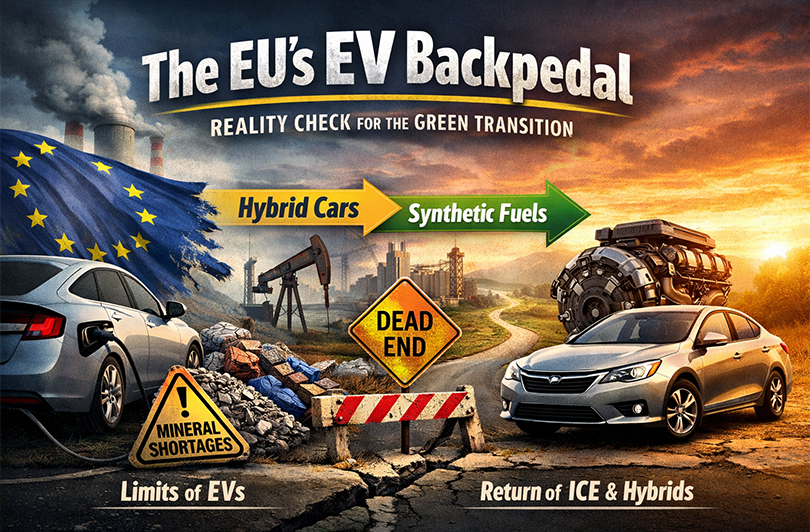
For the last decade, internal combustion engines have been treated as politically inconvenient rather than technically relevant. Targets were set, bans announced, and the motor trade was told — with little nuance — that electric vehicles were the only acceptable future.
Now the EU is quietly stepping back.
Deadlines are being softened. Exemptions are appearing. Hybrids are back in scope. Synthetic fuels are being discussed. This isn’t climate denial — it’s policy finally colliding with reality.
Because you can’t legislate your way around physics, geology, and infrastructure.
The EV Transition Has a Raw Materials Problem
The electric car rollout was sold as a manufacturing challenge. Build more factories, scale batteries, job done.
That was never the real problem. Mining is.
New analysis from Kearney, working with the World Economic Forum, shows existing global lithium supply will only meet around 35% of predicted 2035 demand. Even if every announced mining project goes ahead — which history suggests is optimistic — supply only reaches 35–45% of forecast lithium and graphite demand.
That’s not a delay. That’s a hard limit.
By 2035:
– EVs are expected to consume 86% of all lithium
– 55% of global cobalt
– And one-third of all rare earth elements
– While rare earth and copper production must rise by over 50%
All of this while the world is also electrifying grids, data centres, heating and industry — all competing for the same finite materials.
You Can’t Fast-Track a Mine
Battery plants can be built in a couple of years. Motor factories scale quickly. Politicians love that bit.
Mines don’t.
New mining projects typically take 10–20 years to develop. Exploration, planning, environmental approvals, infrastructure and refining move at geological speed, not political speed. There is a fundamental timing mismatch between EV ambition and material reality — and no amount of wishful thinking fixes it… nor will dumb ill-informed politicians.
EVs Have a Place — Just Not Everywhere
Electric vehicles absolutely have their place.
In dense cities with short journeys, good charging coverage and abundant solar — think somewhere like Seville — EVs can work very well.
But context matters.
An electric delivery van in the Scottish Highlands, covering long distances, in cold weather, with patchy charging infrastructure, is about as useful as a chocolate fireguard. One-size-fits-all policy ignores geography, climate, use case and physics — and ends up pleasing nobody on the ground.
Hybrids: The Quietly Sensible Solution
This is where modern hybrids deserve far more credit.
Today’s hybrids are extremely efficient, ultra-low emission and highly practical. They massively reduce fuel use and particulates without needing large, resource-intensive battery packs. They spread scarce minerals across far more vehicles. They work with existing infrastructure. They deliver genuine emissions reductions now.
A modern hybrid produces a fraction of the pollution of older ICE vehicles and avoids the material and grid burden of full EVs. From an engineering and environmental perspective, that matters far more than political slogans.
And the MOT Trade Is Being Asked to Pay Up
There’s another reality rarely acknowledged.
MOT testing stations are now facing likely mandatory investment in particle counter machines, because the UK’s current diesel emissions testing technology is outdated.
That’s not trivial. It’s £5,000–£6,000 per MOT bay, plus ongoing calibration and servicing costs. Many independent garages — already operating on tight margins — won’t be thrilled at another unfunded mandate quietly passed down the chain.
Cleaner vehicles are welcome. Pretending the costs don’t land on small businesses is not.
Pragmatism Beats Posturing
The EU’s backpedal isn’t failure — it’s realism.
A mixed future of modern ICE, highly efficient hybrids, EVs where they actually make sense, and alternative fuels will cut emissions faster and more reliably than betting everything on supply chains and infrastructure that simply aren’t ready.
The future of transport won’t be ideological.
It’ll be practical, engineered — and hybrid-heavy.